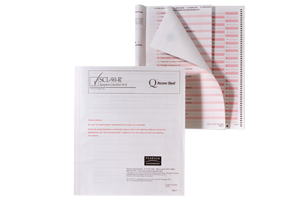
SCL-90-R®
(Symptom Checklist-90-Revised)
Author: Leonard R. Derogatis, PhD
| The Symptom Checklist-90-R (SCL-90-R) instrument helps evaluate a broad range of psychological problems and symptoms of psychopathology. The instrument is also useful in measuring patient progress or treatment outcomes.
The SCL-90-R instrument is used by clinical psychologists, psychiatrists, and professionals in mental health, medical, and educational settings as well as for research
purposes. It can be useful in: |
 |
- Initial evaluation of patients at intake as an objective method for symptom assessment
- Measuring patient progress during and after treatment to monitor change
- Outcomes measurement for treatment programs and providers through aggregated patient information
- Clinical trials to help measure the changes in symptoms such as depression and anxiety
- The SCL-90-R test contains only 90 items and can be complete in just 12-15 minutes.
- The test helps measure 9 primary symptom dimensions and is designed to provide an overview of a patient's symptoms and their intensity at a specific point in time.
- The progress report graphically displays patient progress for up to 5 previous
administrations.
- By providing an index of symptom severity, the assessment helps facilitate
treatment decisions and identify patients before problems become acute.
- The Global Severity Index can be used as a summary of the test.
- More than 1,000 studies have been conducted demonstrating the reliability,
validity, and utility of the instrument.
Leonard R. Derogatis received his Ph.D. from Catholic University in 1965, and began his academic career at the Biometrics Laboratory of George Washington University, where he was involved in the design and analysis for NIH-sponsored clinical drug trials. He subsequently accepted a position at the Johns Hopkins University School of Medicine where he was on the faculty for 21 years, 12 of them as Director of the Division of Medical Psychology, and Chief Psychologist of the Johns Hopkins Hospital. While at Hopkins, Dr. Derogatis became involved with sexual medicine as one of the early faculty attending in the Hopkins Sexual Behaviors Consultation Unit.
Dr. Derogatis has authored more than a dozen psychological test instruments, and over 120 scientific papers. He has been the recipient of numerous federal grant awards, and has served as principal investigator on many multi-center clinical drug trials in the treatment of male and female sexual dysfunctions. In 2003, Dr. Derogatis returned to Johns Hopkins to direct the new Center for Sexual Medicine, and most recently in 2006, moved the Center to Sheppard Pratt Hospital in Baltimore County. His personal research is currently primarily in the area of sexual medicine, where he is doing sponsored research on the screening, diagnosis and treatment of sexual disorders.
Symptom Scales
SOM - Somatization
O-C - Obsessive-Compulsive
I-S - Interpersonal Sensitivity
DEP - Depression
ANX - Anxiety
HOS - Hostility
PHOB - Phobic Anxiety
PAR - Paranoid Ideation
PSY - Psychoticism
Global Indices
Global Severity Index (GSI): Designed to measure overall psychological distress.
Positive Symptom Distress Index (PSDI): Designed to measure the intensity of symptoms.
Positive Symptom Total (PST): Reports number of self-reported symptoms.
Adapted from the SCL-90-R test, the revised test is normed on 4 groups:
- Adult psychiatric outpatients
- Adult nonpatients
- Adult psychiatric inpatients
- Adolescent nonpatients
The interpretive report is based on age-appropriate nonpatient norm groups; adolescent norms are used for 13- to 17-year olds, and nonpatient adult norms are used for subjects over age 17.
Profile Report (Product Number 51430)
This report can be useful for monitoring change. It presents a graphic profile of raw and normalized T scores
for each of the 9 Primary Symptom Dimensions and the 3 Global Indices.
For adults, T scores are profiled based on your choice of nonpatient, outpatient or inpatient norms. (The T scores for the remaining norm groups are printed below the profile.) For adolescents, T scores
are reported using adolescent nonpatient norms.
View a sample Profile Report.
Interpretive Report (Product Number 51431)
In addition to providing a profile of scores, the interpretive report
provides a narrative overview of the client's symptoms at the global level
and specific statements describing the individual symptom scale scores. The Pathognomonic Signs section of the report notes disorders that
might be present given the pattern and intensity of symptom endorsement. A
Symptoms of Note section lists all items to which the client responded
"extremely" or "quite a bit."
View a sample Interpretive Report.
Progress Report (Product Number 51432)
This report can help monitor a client's progress over time.
It graphically displays scale-by-scale
changes in a client's scores for up to 5 previously reported administrations.
View a sample Progress Report.
Q Local Software - Enables you to score assessments, report results, and store and export data on your computer.
Mail-in Scoring Service - Specially designed answer sheets are mailed to us for processing within 24-48 hours of receipt and returned via regular mail.
Hand Scoring - Administer assessments on answer sheets and score them quickly yourself with an answer key.
Optical Scan Scoring - Allows you to score the assessments at your site.
Do any of the SCL-90-R reports contain all of the normative groups?
The SCL-90-R MICROTEST QTM Interpretive and Profile Reports provide information on all three adult normative groups: Nonpatient, Outpatient, and Inpatient. The SCL-90-R profile report graphically displays the data using the norm group of your choice. The SCL-90-R interpretive report graphically displays the data using the nonpatient norms. The T scores for the other normative groups are listed below the graph.
Is the SCL-90-R available in other languages?
The SCL-90-R assessment is available in Spanish and French for Canada. Forms for the Spanish version are available for use with the MICROTEST Q system and hand-scoring. Forms for the French for Canada version are available for use with hand-scoring only.
What is the difference between the SCL-90-R assessment and the original
SCL-90 assessment?
The SCL-90 assessment is an unnormed precursor to the SCL-90-R assessment. The original SCL-90 anxiety scale did not work and its obsessive-compulsive scale was very weak. After the assessment was revised, norms were developed for the revised assessment (SCL-90-R), and the BSI® assessment was developed from that. Most research has been conducted using the SCL-90-R and BSI instruments.
|